Posts

Down With Ordinary Ladies!
Image
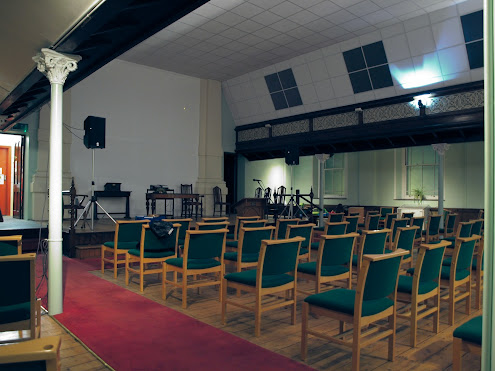
 Welcome back, everyone! We are back for a few more weeks of film nights after our brief recess. I am happy to announce that we are also back upstairs in the Main Hall (or "Screen One" as I like to call it) now that the essential repairs have been completed. A great big thank you to everyone for your patience and understanding while we showed films in our "temporary accommodations" downstairs in the basement ("Screen Two"!). I plan to show three more films in December before we break for the holiday season, and we will then resume on the 12th of January with a brand-new film series (more about that in due course, so stay tuned!). For our first December screening (on Thursday, the 1st of December) I want to draw a line under our recently concluded series of Ordinary Ladies with a film that is, effectively, the antithesis of Ordinary Ladies. The Stepford Wives (1975) is based on Ira Levin's 1972 novel, and plays out like Betty Friedan's darkest in...

Ordinary Lady in Stereo (where available)

Image
 I know I introduced last week's film as The Last Ordinary Lady (and those of you who saw the film will understand why) but we have time to squeeze one more "bonus" lady into the series before we move on to other topics. Those of you who know me at all will be aware of my love for all things stereoscopic, and I try to include at least one 3D film in each series. In this instance, the choices were surprisingly limited; something that tells you a lot about mainstream cinema's attitudes toward female characters. In fact, I was able to come up with exactly one film that fit the Ordinary Lady criteria, so, unsurprisingly, that is the film I will be showing next week! (Presumably that means there was actually  no choice, since you can't really choose between a single option. But I digress...) Fortunately, the film in question happens to be a lot of fun: Monsters Vs Aliens was released in 2009, at the very beginning of Hollywood's modern 3D era. Hollywood has actu...

The Last Ordinary Lady.

Image
All things eventually die. For the past several months, I have been showcasing films devoted to Ordinary Ladies (as I have been calling them). These ladies have been characters who would (in other circumstances) have lived at the margins of the narrative; they were the girlfriends, the wives, the little old ladies, the aliens from outer space(!). Films are not usually about them , and everyone else in the narrative just assumes that they are going to be the supporting characters. But ignore an Ordinary Lady at your peril. This Thursday (the 3rd of November) we will be screening the final entry in this series.  Our final Ordinary Lady. In the wholesome world of slasher movies, there is a narrative trope that is referred to by connoisseurs as the Final Girl . Most slasher films follow a basic formula: some monstrous thing threatens a group of photogenic youngsters who have had the misfortune to get themselves trapped in whatever location they are in (a haunted summer camp; a cabin i...

Ordinary Lady From Outer Space

Image
This week is, of course, Halloween - probably my favourite holiday of the year (with the possible exception of National Bubble Wrap Appreciation Day, but that's another story).  This Thursday I want to show an appropriate Halloween film, as has become a tradition for these weekly film nights, so I am proud to present the most terrifying Ordinary Lady you will ever encounter (and, no, I don't mean Liz Truss, so stop sniggering in the back). Admit it: you just googled National Bubble Wrap Appreciation Day, didn't you? The mid-Twentieth Century was an era of paranoia. Politically, American society was whipping itself into a frenzy over an imagined Communist plot to overthrow the US Government, but a general fear of unseen threat was more widespread than the specific "Reds Under the Beds" scare. For many people (especially people of a certain age) everything about the society they used to know seemed to be in flux, and it was easy for them to imagine that they were s...

Ordinary Lady Passes for White

Image
 A few weeks ago, we saw Cary Grant as the (slightly reluctant) Ordinary Lady of I Was a Male War Bride ; Howard Hawks' comedy of bureaucracy and gender identity. This week's film looks at a very different kind of identity. Nella Larsen's novel Passing was originally published in 1929 and tells the story of two African American childhood friends (Clare and Irene) who re-connect as adults following a chance encounter in the city. Irene has settled down to (apparently) happy married life in Harlem with a successful doctor, while Clare is "passing" as a white woman. She is married to an openly racist white man who has no idea that his own wife is actually black. We may be currently living in an age where people are increasingly "choosing" their gender (you must have noticed that one of the unlikeliest weapons in the modern Culture War is the humble pronoun ) but the practice of choosing your race is historically much more complicated and socially treacher...

Ordinary Lady talks about the rain (in Spain)

Image
 As we approach the final stretch of our series devoted to Ordinary Ladies , I think it's only fair that we pay a visit to arguably the most famous and beloved Ordinary Lady of them all: Eliza Doolittle. Eliza Doolittle is of course best known in modern society because of the Lerner and Lowe musical My Fair Lady , first performed on Broadway in 1956 and eventually filmed in 1964 (and portrayed by Julie Andrews and Audrey Hepburn, respectively). But before My Fair Lady , there was Pygmalion , George Bernard Shaw's highly successful 1913 play, and his own cinematic adaptation of it in 1938 (starring Wendy Hiller). It is that version that we'll be showing this Thursday (the 13th of October). Today, Pygmalion has a slightly unfortunate legacy as The Play That Launched a Thousand Rom-Coms (at least the ones of the "rags-to-riches" variety). Shaw's play has become the inspiration for any number of heart-warming stories about nerdy, unnoticed, awkward girls who are c...

Ordinary Lady Survives Auschwitz

Image
What's the Opposite of Vertigo ?  In 1975, film theorist Laura Mulvey published her landmark essay, Visual Pleasure in Narrative Cinema , in which she argues that the very act of watching a film is inherently masculine. The pleasure an audience derives from watching characters on a screen (she asserts) is a voyeuristic pleasure that turns those characters (female characters in particular) into objects for our satisfaction. It was this paper that was to popularise the term "Male Gaze". In backing up her idea, Laura Mulvey cited several films that are essentially built around the notion of voyeurism; most of them directed by Alfred Hitchcock (which possibly tells you more about Hitchcock than it tells you about cinema in general). Chief among those films was his 1958 masterpiece Vertigo . Much has been written about Vertigo over the decades, and I am not about to get drawn into all of that right now. For our current purposes, Vertigo tells the story of a retired detective w...